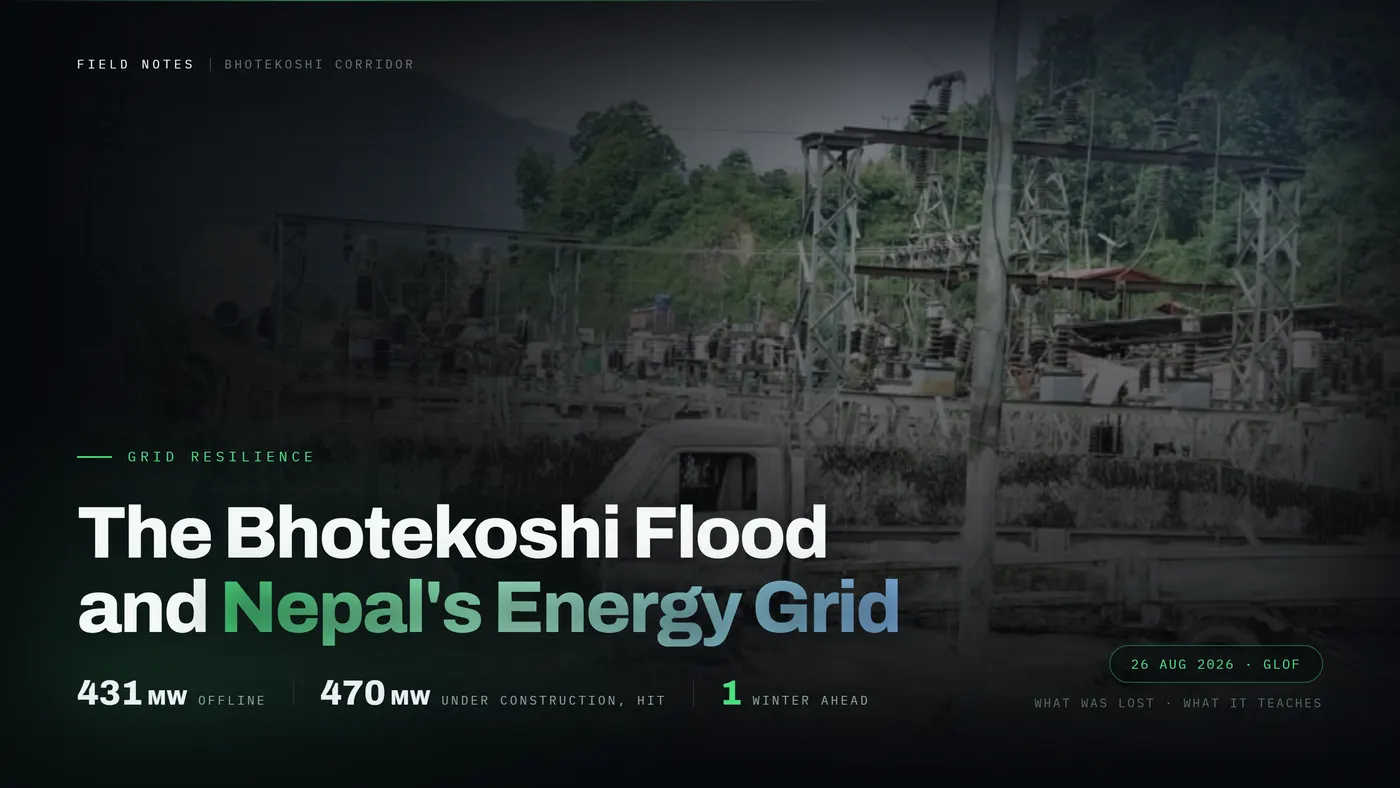
I have spent the last two weeks refreshing news pages and scanning the rescued and missing lists NEA, the Army and IPPAN have put out, looking for names I recognise.
Several of my classmates, juniors and seniors from Kathmandu University were working in the Bhotekoshi and Trishuli corridor when the flood came through. Some are fresh graduates who took internships at these projects. Others joined as site engineers a year or two after finishing the same degree I did. Some of them are still not accounted for.
What happened
At around 08:40 on Wednesday, 26 August 2026, a wall of water came down the Bhotekoshi river, which enters Nepal from Tibet in Rasuwa district.
An ice and rock avalanche from a glacier blocked a Bhotekoshi tributary called the Lhende Khola, then let go all at once. This is the second time in fourteen months that this same small river has flooded. A similar event in July 2025 was traced to a glacial lake bursting on the Tibetan side.
The flood swept down through Timure and Syabrubesi, then into the Trishuli river, then downstream through Nuwakot, Dhading, Gorkha and as far as Chitwan. The government’s damage survey now counts 37 motorable bridges, 68 suspension bridges and 55 kilometres of road destroyed, well above the first rough estimate given in the days right after the flood.
As of the government’s situation update on 7 September 2026, the thirteenth day of the response: 1,355 bodies have been recovered, around 5,000 people are still missing (including roughly 600 foreign nationals from 35 countries), and 13,396 people have been rescued. These numbers change daily as search teams keep working, so treat anything you read here as a snapshot, not a final count.
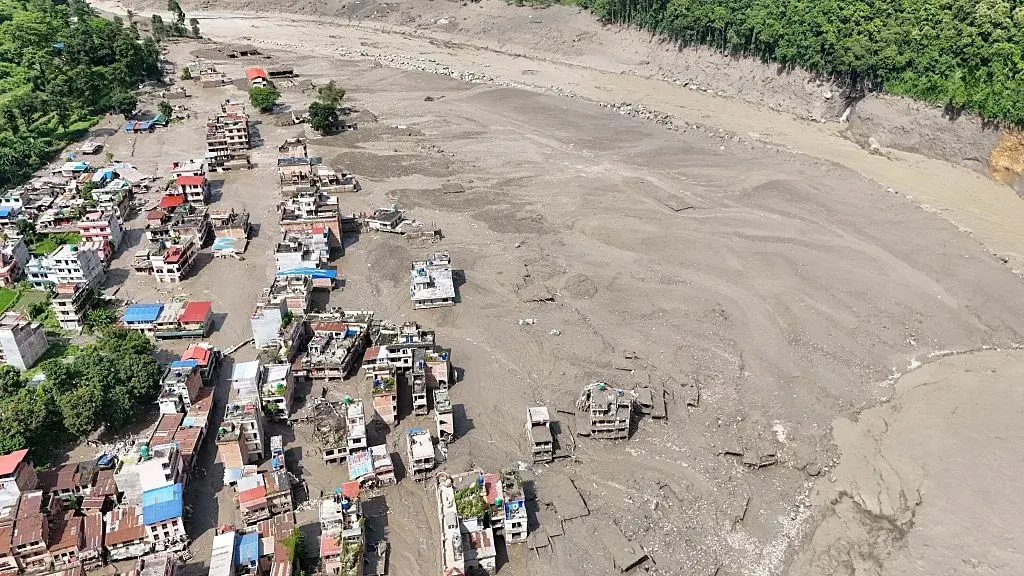
Image Source: Internet
If you want to see how the flood actually unfolded, France 24 put together a minute by minute reconstruction of the day.

431 MW went offline in a morning, and the fuller number is worse
Nepal Electricity Authority’s first damage notice listed twelve power stations shut down in the affected river basin.
| Plant | Capacity |
|---|---|
| Rasuwagadhi Hydropower | 111 MW |
| Salasungi (Sanjen) | 78 MW |
| Upper Trishuli 3A | 60 MW |
| Sanjen | 42.5 MW |
| NEA Solar Project | 25 MW |
| Trishuli | 24 MW |
| Chilime | 22 MW |
| Langtang | 20 MW |
| Upper Sanjen | 14.8 MW |
| Upper Mailung | 14.8 MW |
| Devighat | 14 MW |
| Mailung Khola | 5 MW |
| Total | 431.1 MW |
That is roughly 10 per cent of Nepal’s entire electricity supply, gone in a single morning. NEA’s first notice also flagged 470 MW of projects still under construction as damaged.
Different groups gave slightly different numbers in that first week, simply because most of the sites were still cut off and nobody could physically inspect the dams and powerhouses yet. As access improved, the government’s own damage assessment settled on a fuller figure: 783 MW of hydropower capacity affected, across 13 hydropower projects, one solar plant and two transmission lines, as reported on 6 September 2026. Treat that as the clearest total so far, not as a correction of the numbers above. A full report on the cost of rebuilding is still being finished.
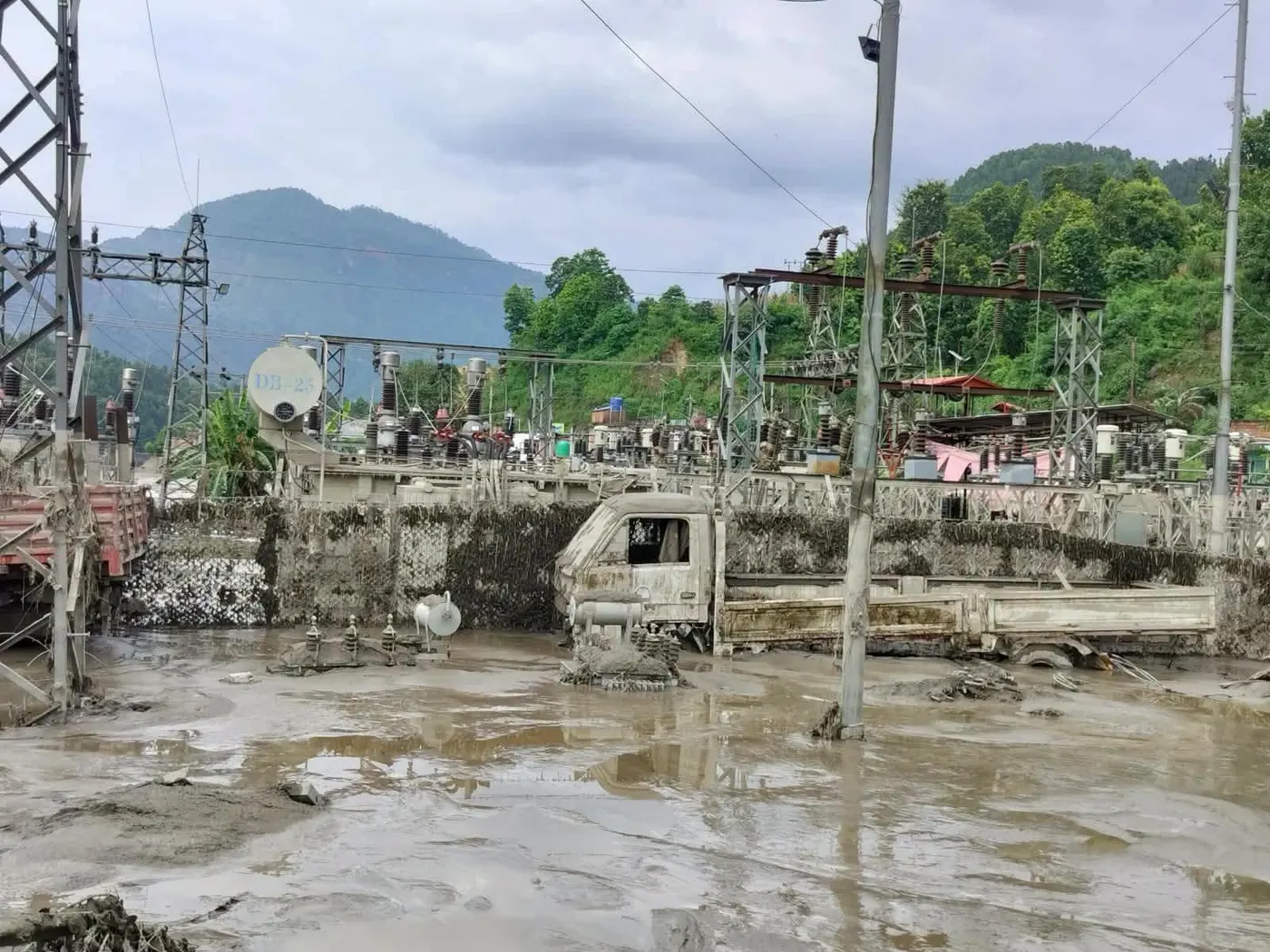
Image Source: Internet
Nepal’s biggest foreign hydropower project may have lost most of its dam
One project deserves its own section, because of what it means for Nepal beyond just the megawatts.
Upper Trishuli 1 is a 216 MW plant being built by two Korean companies, Korea South East Power and Doosan Enerbility, at a cost of around USD 647 million. It is one of the largest foreign investments Nepal has ever attracted, put together with the kind of layered international financing that only a project this size can access, and other investors were watching it closely as a test of whether Nepal is a safe place to put that kind of money.
Reports since the flood say more than 90 per cent of the project’s upper dam was destroyed. Construction was about 84 per cent finished before the flood hit. Analysts now expect the total cost to climb past USD 800 million once rebuilding is included.
Nine South Korean nationals working on the project, six from Doosan Enerbility and three from Korea South East Power, are still among the missing. South Korea’s foreign minister, Cho Hyun, flew to Nepal in the first week of September to help coordinate the search and to talk with Nepal’s government about what comes next for the project, including how South Korea might support rebuilding it.
Whether Upper Trishuli 1 gets rebuilt, and how fast, will say a lot about whether Nepal can keep attracting the kind of foreign money it needs to build its next generation of power plants.
Nepal’s largest solar plant is also gone
A line in that damage list has had almost no attention. The 25 MW NEA solar plant in Nuwakot, the country’s biggest single solar installation, was badly damaged, with three sections of the array and its substation washed away.
There is a hard lesson in this. Solar was meant to be the backup that did not depend on rivers and rainfall the way hydropower does. But this plant was built right next to the hydropower stations it was meant to complement, on the same river terrace, so it was hit by the exact same flood. Building a different kind of power plant does not lower your risk if you build it in the same place.
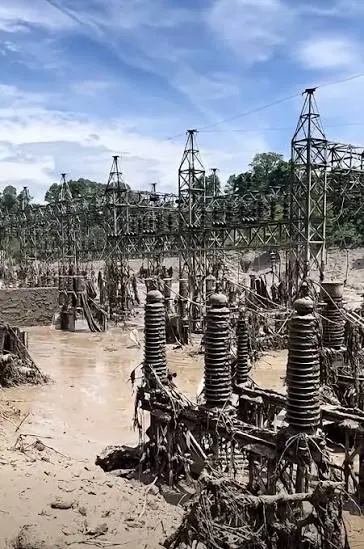
Image Source: Internet
The power lines matter as much as the power plants
Generation gets the headlines, but the wires and substations that carry electricity to Kathmandu may take even longer to fix.
The Trishuli 220 kV hub substation, a key piece of equipment, was completely destroyed. Several other lines connecting Chilime, Trishuli and Kathmandu were knocked out or blocked by debris. A substation like this cannot be bought off a shelf; ordering and building a new one takes years, not months.
That means even once a damaged power plant like Rasuwagadhi is repaired, it still cannot send electricity anywhere until the lines carrying that power are rebuilt too. The generation and the wires were both destroyed by the same flood because they were both built along the same river.
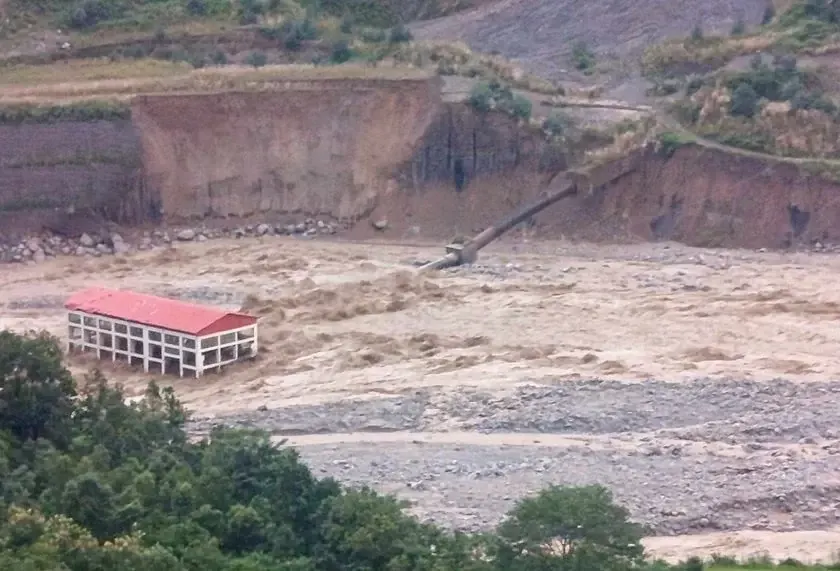
Image Source: Internet
Rasuwa district lost power completely, and parts of Nuwakot, Dhading and Gorkha lost it too. One local substation in Dhading was buried under about five feet of mud and had to be dug out with excavators.
The people
Behind every megawatt number is a person. NEA’s own notice listed workers who could not be reached, project by project, adding up to 196 people just from NEA sites. IPPAN, which represents private power companies, put the number across all affected projects at 933 people initially unreachable, of whom 254 had already been rescued within the first two days.
At Rasuwagadhi, the company believed three to six people might still be trapped inside an underground powerhouse several storeys deep. A company official told the Kathmandu Post they were hoping the trapped workers were safe as long as the air pipes into the powerhouse had not been blocked. That line has stayed with me since I read it.
At the Langtang Khola project, a 20 MW plant that had just finished construction and was two days from starting testing, 60 workers were cut off, 35 of them inside a tunnel. The Nepal Army has been pulling people out of tunnels by hand, working through frozen mud, and has rescued 254 people from Upper Trishuli 1 alone.
Working conditions deserve a real conversation
I want to say something that will not be popular in the sector.
The people who were in those tunnels are engineers and technicians, many of them young, some from my own department at university, a year or two behind me. They took these jobs because they were the jobs available. Pay is modest, contracts are short term, and postings are often in remote places with little medical care nearby. This flood showed everyone what the worst case actually looks like.
Nepal’s hydropower industry talks constantly about megawatts, tariffs and returns on investment. It talks far less about the people who build and run the plants: what safety standards exist for underground construction, whether there are early warning systems tied to the rivers above a project, and what insurance actually covers if something goes wrong.
If you are a young engineer thinking about taking a site job, I am not telling you not to. Most engineers in Nepal start that way, myself included. Just ask what the evacuation plan is, whether there is a warning system for the river above the site, and what your insurance actually covers, before you sign anything.
What is being done right now
Power is slowly coming back. NEA has rigged temporary workarounds to restore electricity to some towns in Nuwakot, and crews are repairing lines wherever they can reach them.
Rescue teams keep growing. Along with Nepal’s own Army, Police and Armed Police, tunnel rescue teams from India, China and South Korea are working with the Army, and teams from the UAE and Malaysia have now joined too.
Communication is being rebuilt. The government is flying in portable mobile towers, powered by generators and solar panels, along with medical supplies and tents.
Small solar systems are being sent to affected areas. The Alternative Energy Promotion Centre has ordered small solar home systems, institutional solar kits and cooking stoves for people who lost everything. It is a small purchase in cost, but a useful one: when the grid and the roads are both gone, a small solar panel that can charge a phone matters more than a distant power plant that cannot reach you.
Companies are chipping in. Doosan, one of the two companies building Upper Trishuli 1, has pledged NPR 5 million toward relief.
What this means for winter
Here is the part that affects everyone’s electricity bill, not just the flood zone.
Nepal makes most of its power from rivers, and river flow drops sharply in the dry winter months, exactly when people use the most electricity. In a normal year Nepal exports over 1,000 MW of extra power during the monsoon and imports power from India through the winter. Losing 431 MW right now, and delaying 470 MW of new projects, shrinks the safety margin Nepal already had for this winter.
My honest read: full scheduled power cuts are possible but not likely. The more probable outcome is that Nepal simply buys more electricity from India this winter, at a higher price than usual, since it is now negotiating from a position of obvious need right after a widely reported disaster. The lost capacity was also earning export income during the monsoon, so this flood costs Nepal on both sides of the year, not just one.
What this teaches us
Everything was built in one place. Rasuwagadhi, Sanjen, Chilime, Trishuli, Upper Trishuli 1 and the Nuwakot solar plant are all in the same river corridor, across just three districts. One flood on one small tributary took out about a tenth of the entire country’s electricity supply, because that is exactly where Nepal chose to concentrate its generation. Hydropower is still the right backbone for Nepal’s grid; it just cannot keep being the only thing Nepal builds, and it cannot keep being built entirely in one place.
New projects need to spread out. Adding solar next to your hydropower, like Nepal did in Nuwakot, does not actually lower your risk if a flood can hit both at once. Nepal needs power plants spread across river basins that do not share the same flood risk, and across provinces that are not all fed by the same transmission lines. That means more solar built on rooftops in the cities that actually use the power, not just more solar built beside more hydropower in the same valleys.
Watching the rivers and keeping backup power ready is cheap compared to what was just lost. The Lhende Khola has now flooded twice in just over a year. Sensors and warning systems on rivers like this cost a small fraction of a single damaged powerhouse, yet very few glacier fed rivers in Nepal have them. At the same time, small battery backup and solar systems at hospitals, water pumps and phone towers can keep essential services running even when the main grid goes down, exactly like the emergency solar kits being flown in right now. Both of these are far cheaper to build before a flood than after one.
That is the engineering side of this story. There is also a separate question about who should pay for a disaster like this, in a country that barely contributes to climate change in the first place. I have written about that separately in climate justice after the Bhotekoshi flood.
What should happen next
- Publish one clear damage number, not several competing ones, so planning and rebuilding can move faster.
- Fix the power lines as a priority, not an afterthought. A repaired power plant is useless if the line to Kathmandu is still broken.
- Require river monitoring for every project built on a glacier fed river, written into the licence itself.
- Require a real evacuation plan for every underground powerhouse and tunnel site, checked before the project is allowed to start operating.
- Spread future projects across different river basins, not just measured in total megawatts but in where those megawatts actually sit.
- Fund small backup power for hospitals, water systems and communication towers before the next flood, not after it.
Nepal keeps nearly half its land under forest and produces well under one per cent of the world’s climate emissions, yet disasters like this keep arriving here first. The glaciers above the Bhotekoshi are not melting because of anything Nepal did. That is the honest, uncomfortable truth sitting underneath everything else in this post.
To the families still waiting for news, and to my friends and juniors still unaccounted for in that corridor: I hope that by the time anyone reads this, the numbers above are already out of date in the only way that matters.
Frequently asked questions
When did the Bhotekoshi flood happen?
At around 08:40 on Wednesday, 26 August 2026. An ice and rock avalanche from a glacier blocked the Lhende Khola, a small tributary of the Bhotekoshi river, which then let go in a sudden surge.
How many power plants were destroyed in the Bhotekoshi flood?
NEA’s first notice listed twelve operating plants shut down, totalling 431 MW, plus 470 MW of projects still under construction. A fuller government assessment published on 6 September 2026 put the total affected capacity at 783 MW, across 13 hydropower projects, one solar plant and two transmission lines.
What happened to Upper Trishuli 1?
More than 90 per cent of the dam at this 216 MW, USD 647 million project was destroyed, and the total rebuilding cost is now expected to pass USD 800 million. Nine South Korean workers on the project are still among the missing.
What caused the Bhotekoshi flood?
An ice and rock avalanche from a glacier blocked the Lhende Khola tributary, which then released in a sudden surge. It is the second time this same small river has flooded in just over a year; a similar event in July 2025 was traced to a glacial lake bursting on the Tibetan side.
What happened to the Nuwakot solar plant?
The 25 MW NEA solar plant in Nuwakot, Nepal’s largest solar installation, was badly damaged, with three sections of the array and its substation washed away.
Will there be power cuts this winter because of the flood?
Possibly, but it is not certain. The more likely outcome is that Nepal buys more electricity from India this winter at a higher price, rather than returning to scheduled power cuts, though the safety margin has clearly narrowed.
Everything above reflects my own research, drawn from NEA and AEPC notices, statements from the Energy Ministry, IPPAN and the Ministry of Foreign Affairs, and news reporting available as of 7 September 2026. Damage figures and casualty counts are still changing. Please check primary sources yourself before relying on any of this for reporting, planning or any other important purpose.
Sources
- Nepal Electricity Authority, head office damage notice
- Alternative Energy Promotion Centre, emergency procurement notice
- Independent Power Producers’ Association Nepal, preliminary assessment
- Ministry of Energy, Water Resources and Irrigation statements, reported via Bloomberg
- Ministry of Foreign Affairs, Government of Nepal, situation updates on the Bhote Koshi river floods, 6 and 7 September 2026
- Ratopati, Korea JoongAng Daily and Korea Herald reporting on Upper Trishuli 1 and the South Korean foreign minister’s visit
- Kathmandu Post, Onlinekhabar, Republica, Himalayan Times, Urja Khabar reporting, 26 August to 7 September 2026