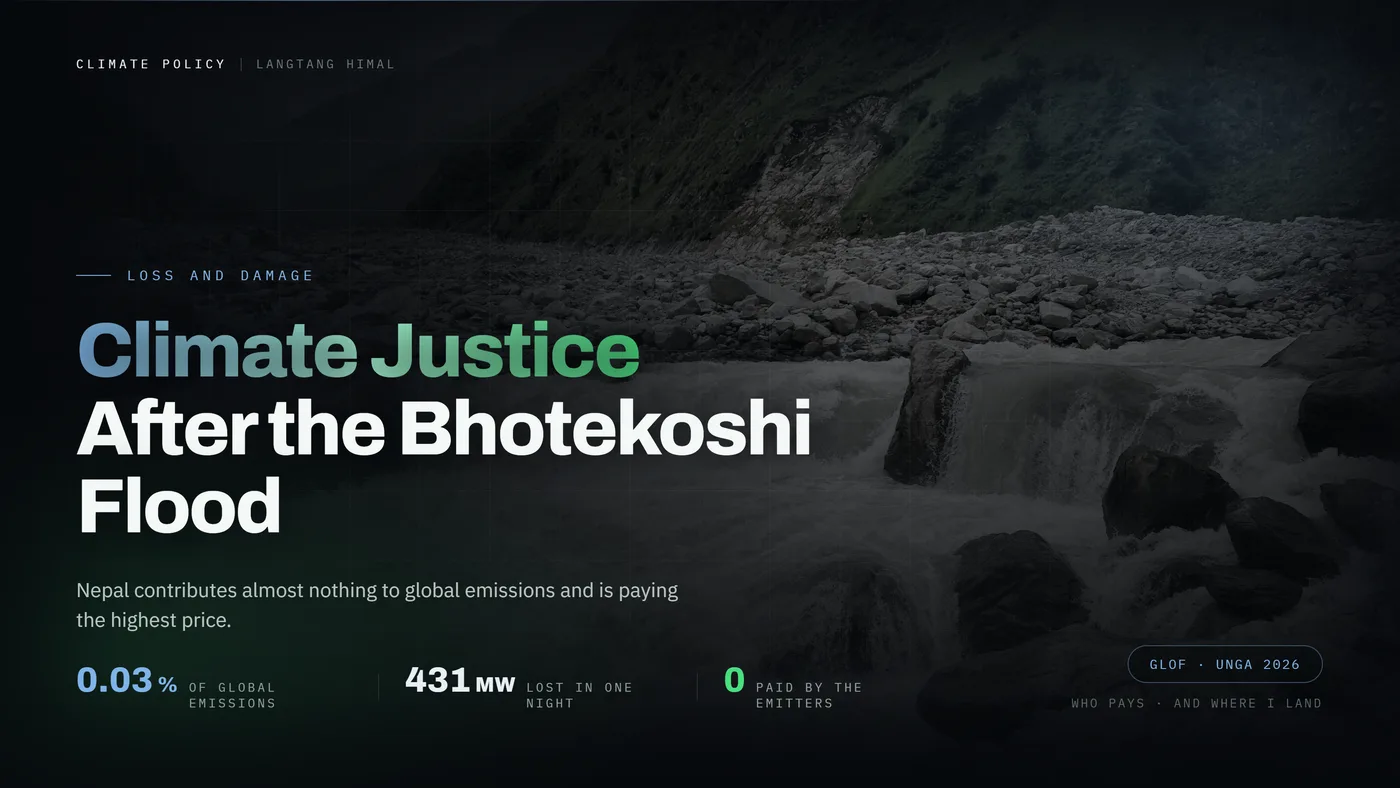
Climate justice is the argument that the countries which caused most of climate change should carry more of the cost of dealing with it, instead of leaving that cost to fall on countries that contributed the least. Nepal is one of the starkest examples of that gap anywhere in the world right now.
Nepal produces less than 0.1 per cent of the world’s greenhouse gas emissions. On 26 August 2026, an ice and rock collapse near Langtang Lirung sent a flood down the Bhotekoshi and Trishuli that has, as of this week, killed more than 1,300 people, left around 4,500 missing, and caused an estimated USD 4 to 5 billion in damage, roughly a tenth of the country’s entire economy.
I wrote separately about what that flood did to the energy grid. This post is about the argument it has reopened: who pays when a country that barely contributes to the problem absorbs the worst of it.
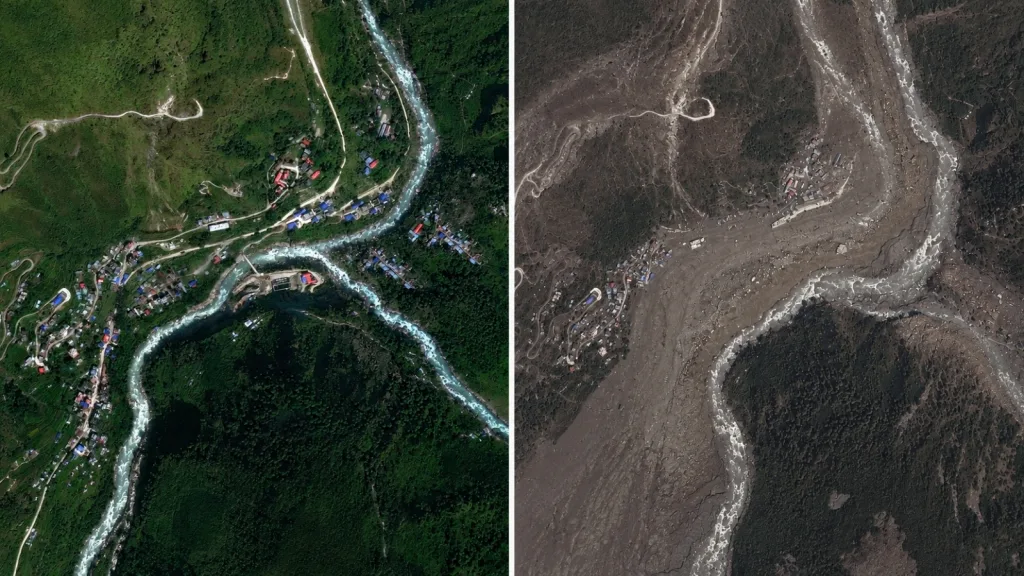 Image Source: The Indian Express
What the scientists were already saying
The disaster did not come out of nowhere. Four months before it, ICIMOD, the regional body that monitors the Hindu Kush Himalaya, reported that snow cover across the region had fallen 27.8 per cent below the long-term average, the lowest level in more than two decades and the fourth straight year of decline.
ICIMOD’s longer record is blunter still. Glaciers in the region are now losing ice at roughly twice the rate seen at the start of this century. In parts of the Himalaya, up to 27 metres of ice thickness has disappeared since 1975. The region is warming at close to twice the global average rate. Even if the world holds warming to 1.5 degrees, ICIMOD’s modelling still shows the Himalaya losing about 30 per cent of its remaining glacier volume by 2100. At 2 degrees, a threshold the world is currently on course to pass, the loss is closer to half.
One detail in the post-disaster analysis stood out to me. Nepal’s glacial lake monitoring has concentrated for years on a small number of well known lakes, Tsho Rolpa and Imja Tsho above all. But the events that have actually killed people in recent years, Rasuwagadhi in July 2025, Thame in August 2024, Tilgau in May 2025, and this collapse in August 2026, all originated from lakes or ice masses that were not on that watch list. The risk is moving faster than the monitoring is.
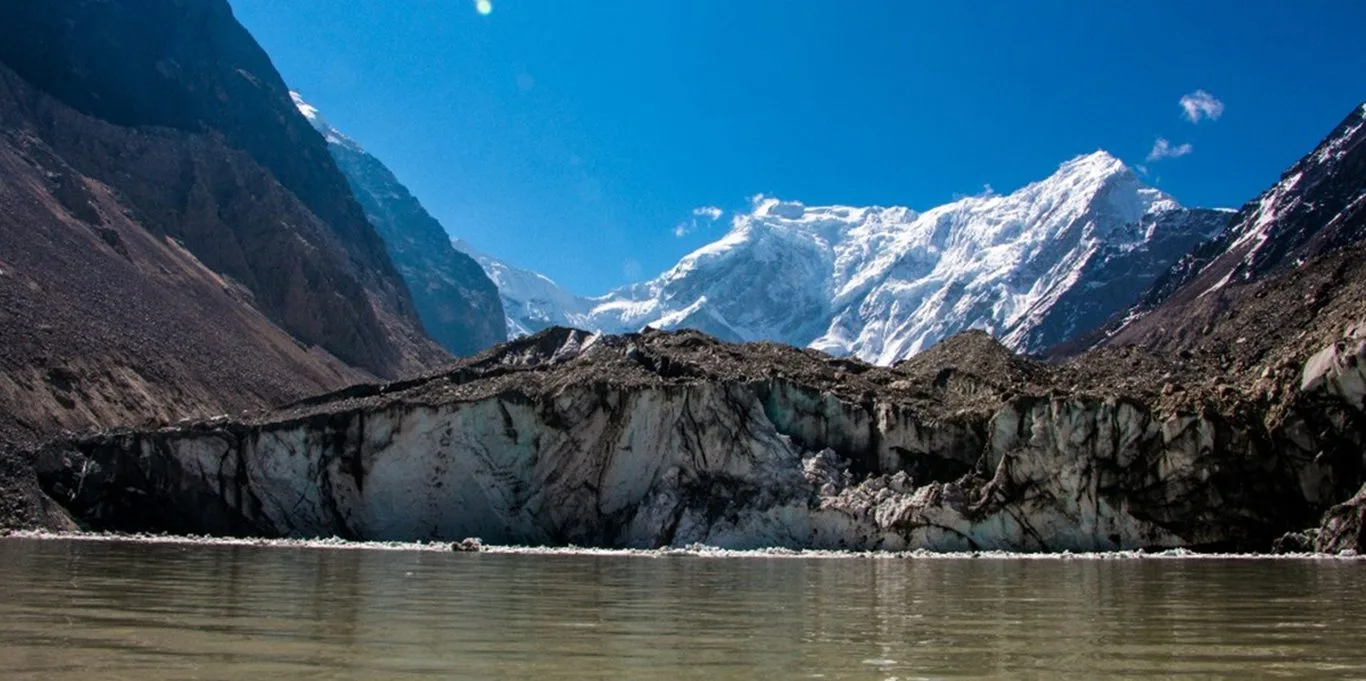 Image Source: ICIMOD
What Nepal’s government has said, and then said again
Nepal’s diplomatic position on this has been unusually visible, and unusually unstable, in the space of a single week.
On 31 August, Foreign Minister Shishir Khanal told Kantipur TV that Nepal would treat disaster assistance as a matter of moral liability rather than charity, and called on the world’s largest emitters to answer for it. China, the United States and India had made “extremely large” contributions to climate change, he said, and left smaller nations enduring the cost of it. Nepal’s Ministry of Finance sent a compensation claim letter to international partners, and the government approached the UN’s Loss and Damage Fund for support. Finance Minister Swarnim Wagle put the rebuilding cost at USD 4 to 5 billion.
Four days later, after meeting the Chinese ambassador and giving an interview to India’s ANI, Khanal said something close to the opposite: “Neither I nor anyone in the Ministry of Foreign Affairs or Government of Nepal has claimed or asked for compensation from India or any other country, including China or the United States.” He said Nepal’s call had been for the world to look at the disaster through the lens of climate change and its impact on the country, not to name a bill to specific governments.
I am not going to pretend that reversal is a small thing. A government does not name three of the world’s largest economies as liable for a disaster and then say, on camera, that it never asked any of them for anything, without something happening in between. Whatever that was, pressure from Beijing and Delhi, a recalibration by a young government still finding its diplomatic footing, or two ministers speaking to two different audiences, the result is that Nepal entered the UN General Assembly this month with a genuinely confused message on the one issue it most needed to be clear about.
Former Foreign Minister Bimala Rai Paudyal, speaking to DW before the reversal, had called this a moment for Nepal to lead a coalition of climate vulnerable nations rather than simply advocate from the sidelines. That is still the right instinct. It is harder to execute when the message changes twice in a week.
Prime Minister Balen Shah, in office since 27 March 2026 after the 2025 Gen Z protests reshaped Nepali politics, was expected to lead the delegation to New York himself rather than send a junior minister. Nepal made a similar case at COP29 in 2024, when President Ramchandra Paudel called climate justice and loss and damage reparations his paramount concern despite the country’s negligible emissions. The demand itself is not new. What is new is the scale of the event now backing it, and the confusion in how it has just been made.
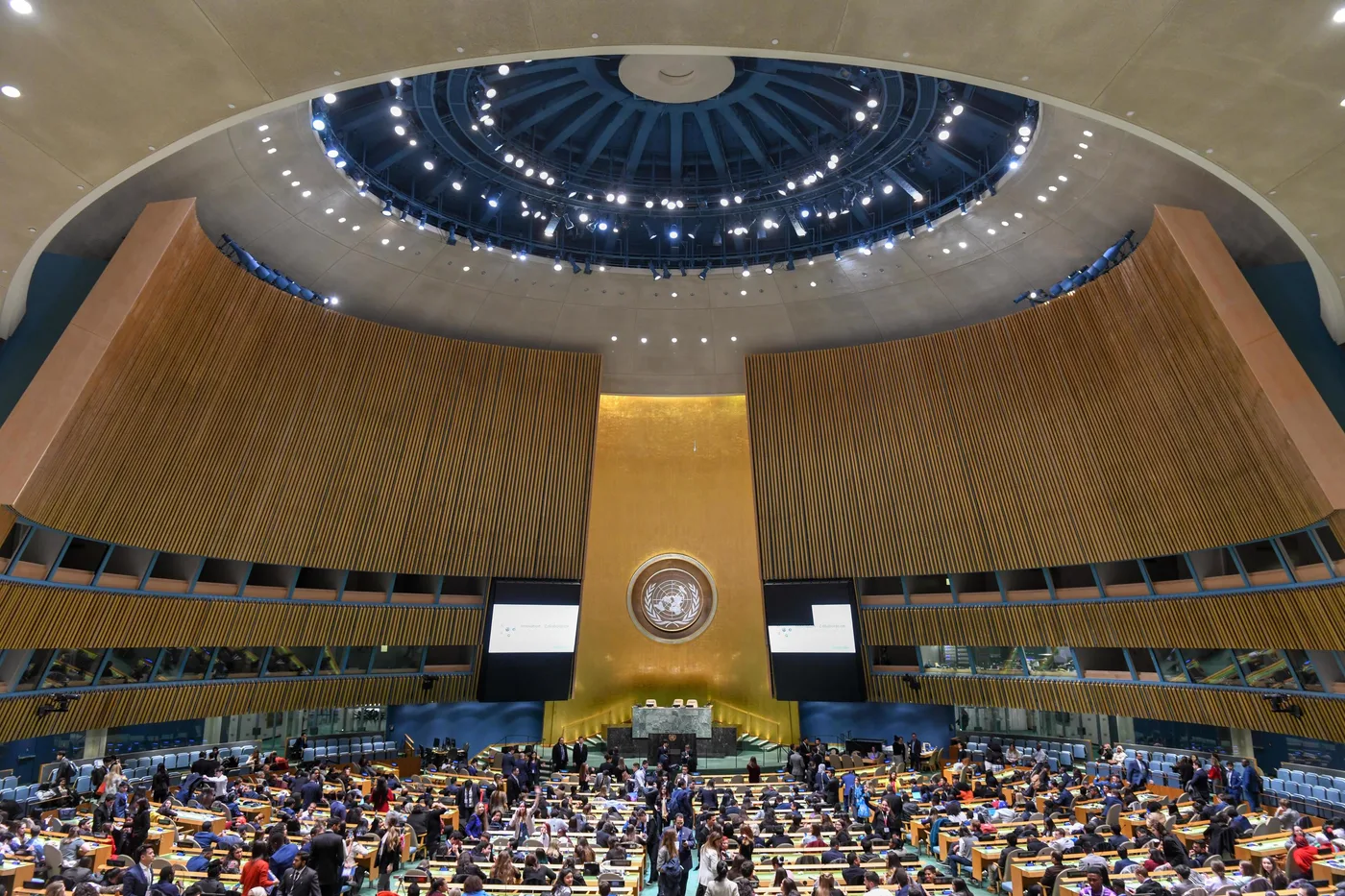 Image Source: Vecteezy
What the world is actually offering
Here is the uncomfortable part. Even a clean, consistent Nepali demand runs into a fund that is not really ready to answer it.
The Loss and Damage Fund, created at COP28 in 2023, depends entirely on voluntary contributions from wealthier nations and carries no legally binding obligation on any of them, including the three countries Nepal briefly named. Around USD 750 million has been pledged globally since, but only a small fraction of that, on the order of USD 10 million, has actually been paid out anywhere in the world. UN Secretary General António Guterres visited the Everest region in October 2023 and told the world to “stop the madness” of climate change, standing in front of Everest to say Nepal had lost nearly a third of its ice in just over three decades. Three years on, the fund his own institution helped create has barely started moving money.
There is also a harder scientific and legal problem sitting underneath the moral one. Establishing exactly how much of a specific disaster’s damage traces back to a specific country’s historical emissions is not a matter of pointing at a chimney. It requires attribution science that can withstand scrutiny, and no such calculation currently exists for the Bhotekoshi flood. The moral case that major emitters bear responsibility is strong. The legal and financial mechanism for translating that into a rupee figure paid by China, the US or India specifically does not yet exist anywhere in the world, for any country.
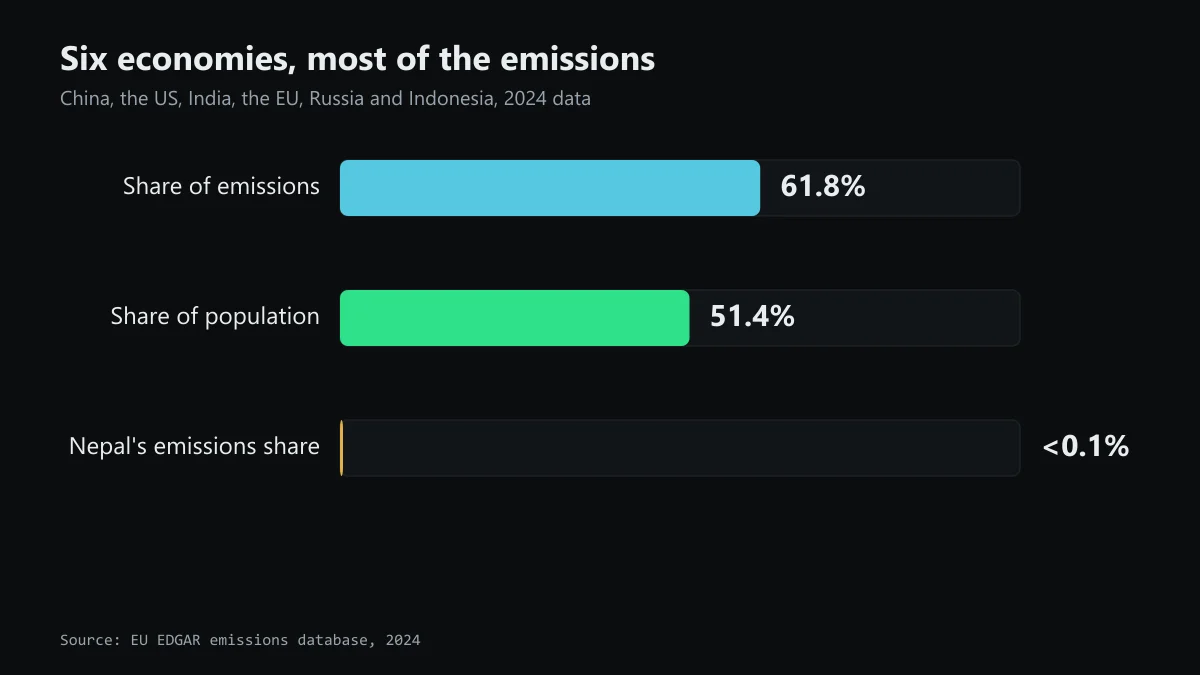
The numbers behind the moral case are not in dispute, at least. China, the United States, India, the EU, Russia and Indonesia together produced 61.8 per cent of global greenhouse gas emissions in 2024 while holding 51.4 per cent of the world’s population, per the EU’s EDGAR emissions database. Nepal’s own share is roughly 89th in the world and rounds to zero. A civil society coalition of 200 international groups, the Global Campaign to Demand Climate Justice, put it plainly this week: Nepal cannot reduce the world’s emissions on the polluters’ behalf, and it should not have to take on more debt to protect its people from a crisis overwhelmingly created elsewhere.
My view
I work in renewable energy in this country, so I am going to be honest about where I land rather than stay neutral for the sake of it.
The moral argument is not complicated and I do not think it needs defending at length. Nepal did not cause this. It is paying for it anyway, in lives, in a tenth of its GDP, and in hydropower and transmission infrastructure that took a decade to build and a morning to lose. That much is simply true, and no amount of attribution science changes it.
What worries me is the gap between the size of that claim and the seriousness of how it was made. Naming three of the world’s most powerful economies as liable, and then saying on camera that it never happened, is the kind of move that costs a small country credibility it cannot easily rebuild. If Nepal wants to lead a coalition of climate vulnerable nations, as Paudyal suggested, that leadership has to survive a phone call from an embassy. This week it did not.
I would rather see Nepal build its case the way an engineer builds a case: with data, with a consistent position held over years rather than one dramatic week, and with the domestic side of the ledger in visible order before asking anyone else to fill the gap. That means the glacial lake monitoring ICIMOD keeps flagging as under-resourced. It means early warning systems on every glacier fed river, not just the two or three lakes everyone already watches. It means the geographic diversification of Nepal’s own energy generation that I have written about separately, so the next flood in one river basin does not take out a tenth of the national grid again. Climate finance, done properly and consistently, is how a country like Nepal pays for exactly that kind of resilience, and I have written about how that money actually reaches a project elsewhere. A single compensation demand, retracted within days, is not a strategy. It is a headline.
The claim is right. The execution, so far, has not matched it. Nepal has the moral standing to lead on this. Whether it has the diplomatic discipline to hold that position for longer than a week is the actual question the UN General Assembly will answer.
Frequently asked questions
What caused the 2026 Bhotekoshi and Trishuli flood?
An ice and rock collapse near Langtang Lirung on 26 August 2026 sent a flood down the Bhotekoshi and Trishuli river corridor. It is part of a pattern: recent glacial lake outburst floods at Rasuwagadhi in 2025, Thame in 2024 and Tilgau in 2025 all came from lakes or ice masses outside Nepal’s main monitoring list.
How many people died in the Nepal Bhotekoshi flood?
More than 1,300 people had died as of the first week of September 2026, with around 4,500 people still missing on both sides of the Nepal China border. The estimated damage is USD 4 to 5 billion, roughly a tenth of Nepal’s economy.
What is climate justice, and why is Nepal invoking it?
Climate justice is the argument that the countries responsible for most greenhouse gas emissions should bear the cost of the damage climate change causes, rather than leaving it to the countries that suffer the most while contributing the least. Nepal produces under 0.1 per cent of global emissions but sits in one of the fastest warming, fastest melting regions on earth, which is the case Nepal is making after the Bhotekoshi flood.
Did Nepal ask China, the US and India for compensation?
Nepal’s foreign minister said so on 31 August 2026, calling disaster assistance a matter of moral liability rather than charity. Four days later he said the opposite on record, stating that neither he nor the Ministry of Foreign Affairs had asked any country, including China, the US or India, for compensation. The reversal happened after meetings with the Chinese ambassador and an interview with an Indian outlet.
What is the UN Loss and Damage Fund, and can Nepal access it?
It is a fund created at COP28 in 2023 to help vulnerable countries recover from climate driven disasters. It runs entirely on voluntary pledges, with no country legally obligated to pay in. Around USD 750 million has been pledged globally, but only a small fraction has actually been disbursed anywhere, which limits how much practical help it can offer Nepal right now.
Which countries emit the most greenhouse gases?
China, the United States, India, the European Union, Russia and Indonesia together produced 61.8 per cent of global greenhouse gas emissions in 2024 while holding 51.4 per cent of the world’s population, according to the EU’s EDGAR emissions database. Nepal’s share of global emissions is close to zero.
Sources
- ICIMOD, Snow Update Report 2026, and longer term glacier monitoring data for the Hindu Kush Himalaya
- Al Jazeera, Kathmandu Post and UN News reporting on the August to September 2026 Nepal and Tibet flood death toll
- ANI, Kantipur TV and Bloomberg reporting on Foreign Minister Shishir Khanal’s compensation statement and subsequent clarification
- European Commission Joint Research Centre, EDGAR emissions database, 2024 data
- UN Framework Convention on Climate Change, Fund for responding to Loss and Damage, pledge and disbursement tracking
- United Nations, Secretary General António Guterres’s October 2023 Everest region visit
- Global Campaign to Demand Climate Justice, coalition statement, September 2026
Where to go next
For what this same flood did to Nepal’s electricity supply, plant by plant, see my post on the Bhotekoshi flood and Nepal’s energy grid. For how climate money actually reaches a project in Nepal, and where it falls short, see climate finance for Nepali energy projects.