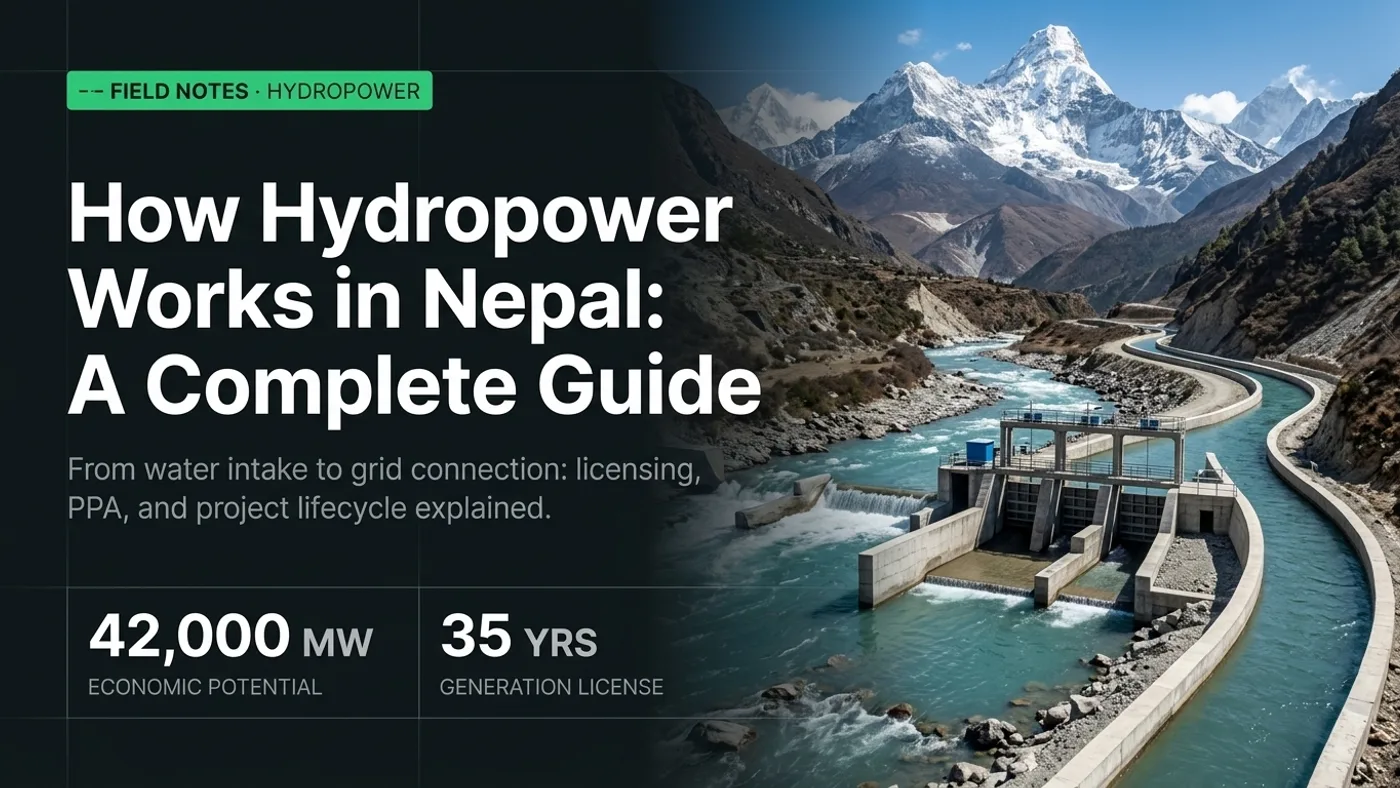
Nepal has more rivers than it knows what to do with. Over 6,000 of them, flowing down from the Himalayas toward India, dropping thousands of metres along the way. That drop is free energy, and Nepal has only used a small slice of it.
This post explains hydropower in Nepal from the ground up. How the electricity actually gets made. Which government offices are involved and what each one does. How a company gets permission to build a plant. What a PPA is and why it matters more than the size of the turbine. And the real steps a project goes through, from someone’s idea to electricity reaching your home.
I have tried to write it so that someone with no background in engineering or law can follow every part of it. Where I use a technical word, I explain it the first time with something ordinary.
Why rivers make electricity
Water sitting high up has stored energy in it, the same way a ball on top of a hill has stored energy before you let it roll. Let the water fall, and that stored energy turns into movement. Nepal’s rivers do this naturally, all day, every day, because the country is a giant staircase from 8,849 metres at the top of Everest down to about 60 metres in the flat Terai plains.
A hydropower plant simply borrows that falling water for a moment, on its way down anyway, and makes it spin a wheel.
The wheel is called a turbine. As the turbine spins, it turns a generator, which is really just a big coil of wire spinning inside magnets. That spinning motion is what creates electricity. It is the same basic idea as a bicycle dynamo lighting up a bulb when you pedal, just built at a much bigger scale.
Two things decide how much electricity a plant can make.
Head is how far the water falls, measured in metres. More fall means more force.
Flow is how much water arrives, measured in cubic metres per second. More water means more force too.
A river with a small drop but a huge amount of water can produce as much power as a river with a tiny trickle falling a very long way. Nepal is fortunate because many of its rivers have both a steep drop and a strong flow, which is exactly why the country is considered one of the best places in the world for hydropower.
How much power is actually there
Engineers use two different numbers when they talk about Nepal’s hydropower potential, and mixing them up causes a lot of confusion.
Theoretical potential is the total energy in all the falling water in the country, as if you could capture every drop with no cost limit. This figure is commonly put at around 83,000 megawatts.
Economically feasible potential is the much smaller number of what could realistically be built and still make financial sense, considering the cost of dams, roads, tunnels and transmission lines. This is usually estimated at somewhere between 42,000 and 45,000 megawatts.
The installed figure keeps moving, month to month, as new plants finish construction, so treat any single number here as a snapshot rather than a fact fixed in stone. The trajectory through 2026 gives a sense of the pace: about 3,878 MW nationally in July 2025, 3,983 MW by January 2026, and reports through mid and later 2026 putting the total between roughly 4,120 MW and 4,296 MW, depending on whether off grid, alternative energy and testing phase projects are counted in the figure. Compare even the higher end of that to the economic potential and Nepal has still built only about a tenth of what it could sensibly build. That gap is the whole story of Nepal’s hydropower sector: enormous potential, and a slow, difficult road to turning it into working power plants. For the current figure, check the Nepal Electricity Authority’s latest annual report or the Department of Electricity Development’s licensing database directly, since it will already have moved past whatever is written here.
The three kinds of hydropower plant
Not every hydropower plant works the same way. Nepal mostly builds three types.
| Type | How it works | Simple example |
|---|---|---|
| Run of river | Water is diverted from the river, used to spin turbines, then returned to the river a short distance downstream. No large reservoir | Most of Nepal’s plants |
| Peaking run of river | Same idea, but with a small pond that stores a few hours of water so the plant can generate extra power during the evening peak, then rest | Upper Tamakoshi |
| Storage or reservoir | A dam holds back a large amount of water in a reservoir, which can be released whenever it is needed, even months later | Kulekhani |
Run of river is the cheapest and fastest to build, which is why most of Nepal’s plants are this type. Its weakness shows up in the dry season, from roughly November to April, when river flow drops and a run of river plant simply produces less electricity, sometimes a third of what it manages in the monsoon.
Storage plants solve that problem because they can save monsoon water for the dry season. They cost far more to build and take much longer, which is why Nepal has very few of them. Kulekhani, built decades ago, is still one of the only real examples.
This difference matters enough that the government now pays different prices for electricity depending on which type of plant produced it, which we will get to later. It is also why a single event in one river corridor can matter so much for the whole country, something Nepal saw firsthand in 2026, covered further down.
Who runs Nepal’s hydropower sector
Building a hydropower plant in Nepal is not a private matter between a company and a river. Several government bodies are involved, each with a different job. Think of it like a school. The principal sets the overall rules, one teacher checks your homework, another manages the timetable, and a separate person handles the school’s money. Miss any one of them and things stop moving.
| Organisation | What it actually does | Think of it as |
|---|---|---|
| Ministry of Energy, Water Resources and Irrigation (MoEWRI) | Sets national energy policy and holds final licensing authority | The principal |
| Department of Electricity Development (DoED) | Processes licence applications, recommends approval or rejection to the Ministry | The office that handles your paperwork |
| Nepal Electricity Authority (NEA) | Generates, buys, transmits and distributes electricity. The only large buyer of power in the country | The shop that buys your product |
| Electricity Regulatory Commission (ERC) | Sets tariffs and technical standards, and now also fixes rates for reservoir projects | The referee who decides what is fair |
| Water and Energy Commission Secretariat (WECS) | Long term planning for water and energy resources | The strategist looking decades ahead |
| Alternative Energy Promotion Centre (AEPC) | Handles small renewable projects under 1 MW, mostly solar, micro hydro and mini grids | The office for smaller, community scale work |
| Investment Board Nepal (IBN) | Approves large projects, generally above 200 MW or above NPR 6 billion in investment | The board that signs off on the biggest deals |
A useful rule of thumb: if a project is bigger than 1 MW, DoED and MoEWRI are involved. If it is bigger than 200 MW or costs more than NPR 6 billion, IBN also gets involved. If it is smaller than 1 MW, AEPC is usually the relevant body instead of DoED.
NEA deserves a special mention because it plays two roles at once. It builds and runs its own power plants, and it is also the only significant buyer of electricity from every other company’s plant. There is currently no other large buyer in the domestic market, which means every private hydropower company in Nepal depends on NEA agreeing to purchase their electricity. That single fact shapes almost everything else in this post, and it is also the subject of my Nepal Policy Forum piece on power trading governance in Nepal, which goes deeper into why one buyer holding that much leverage is a structural problem, not just an inconvenience.
The laws behind the sector
A handful of laws form the legal skeleton of Nepal’s hydropower sector. You do not need to memorise these, but knowing what each one covers helps everything else make sense.
| Law | What it covers |
|---|---|
| Electricity Act, 2049 (1992) | The core law. Licensing for survey, generation, transmission and distribution |
| Water Resources Act, 2049 (1992) | Who has the right to use river water, and how |
| Environmental Protection Act, 2053 (1997) | Requires environmental study before construction, sized to the project |
| Hydropower Development Policy, 2058 (2001) | Opened the door for private investment in hydropower |
| Electricity Regulatory Commission Act, 2074 (2017) | Created the ERC and gave it authority over tariffs and technical rules |
| Public Private Partnership and Investment Act, 2075 (2019) | Governs the largest projects, those above 200 MW or NPR 6 billion |
The Electricity Act of 1992 is now over three decades old, and people inside the sector have been saying for years that it needs replacing. A new Electricity Bill has been drafted, withdrawn, redrafted and resubmitted to parliament more than once since 2018, and as of 2026 it still has not passed. Until it does, the 1992 Act remains the law that governs how a hydropower project gets built in Nepal. For how that slow moving policy environment fits into the bigger picture of Nepal’s energy transition, see my Nepal Policy Forum article on the evolution of energy policy in Nepal.
How a project gets permission to exist
This is the part most people find confusing, so here it is as simply as possible.
Think of it like getting a driving licence. First you get a learner’s permit, which lets you practise but not drive properly yet. Only after you prove you are ready do you get the full licence.
Step one: the survey licence. This gives a company permission to study a site, measure the river, check the geology and figure out whether a plant makes sense there. It does not allow any construction. A survey licence normally runs for 5 years, extendable.
Step two: the generation licence. Once the studies are done and the project looks sound, the company applies for permission to actually build and operate the plant. The law allows up to 50 years, though in practice DoED usually grants 35 years.
That figure is specific to hydropower. Solar and other alternative energy projects run on a separate licensing track under the Grid Connected Alternative Energy Working Procedure, with a generation licence term of 25 years under its section 4, not the hydro figure above. Worth knowing if you are comparing a hydro and a solar project side by side.
No licence is required at all for projects smaller than 1,000 kW, which is 1 MW. Below that threshold, a developer can proceed without going through DoED.
A pause worth knowing about
In mid April 2026, the Minister for Energy, Water Resources and Irrigation directed DoED to stop issuing new survey licences for hydropower, solar and other energy projects until it published a complete list of every existing licence, along with each project’s contractual milestones and compliance record. DoED continued accepting applications, but new licences stopped being issued from that point. The instruction originally set a 60 day window for the review, but reporting through the following months showed the pause still in effect well past that, with the process for what happens next still being worked out.
This is exactly the kind of detail that goes stale fast. If you are actually planning to apply for a survey licence, check DoED’s current status and its Citizen’s Charter (नागरिक बडापत्र) directly, or contact the Licensing Division (अनुमतिपत्र महाशाखा), rather than relying on the date given here.
The survey licence process, step by step
- The company chooses a river and a stretch of it, making sure it does not overlap with a project someone else already holds
- It submits an application to DoED, along with maps and basic project information
- DoED checks whether the paperwork is complete
- If something is missing, the company is asked to fix it and resubmit, usually within about 35 days
- Once everything is in order, DoED forwards its recommendation to the Ministry
- The Ministry reviews it and, if satisfied, issues the survey licence through DoED
The generation licence process, step by step
- The company submits its application, backed by the completed feasibility study
- DoED reviews the documents for completeness
- A public notice is published, giving anyone with a concern about the project 35 days to raise it
- DoED considers any comments received and may ask the company to revise its application
- DoED forwards its recommendation, along with a draft licence, to the Ministry
- The Ministry does its own review and, once satisfied, issues the generation licence through DoED
At every stage there is a chance to be sent back for revision, which is one of the reasons hydropower projects in Nepal can take years just to reach the construction stage, before a single piece of equipment arrives on site. Licence fees also vary by project size and change from time to time, so confirm the current schedule directly with DoED rather than relying on a figure quoted anywhere else, including here.
IEE and EIA: the environmental checkup
Before any hydropower project can be built, Nepal requires an environmental study. There are two levels, and which one applies depends on how big the project is.
Think of the difference as a quick checkup at a local clinic compared to a full body scan at a major hospital.
Initial Environmental Examination, or IEE, is the lighter study. It applies to hydropower projects between 1 and 50 MW. It must be approved within about 21 working days.
Environmental Impact Assessment, or EIA, is the deeper study. It applies to any project above 50 MW, or any project that would clear more than 5 hectares of forest, or any project inside a national park or protected area. It takes longer, usually up to 90 days, and it requires a public hearing where local communities can raise concerns directly.
| IEE | EIA | |
|---|---|---|
| Used for | Smaller projects, generally 1 to 50 MW | Larger projects, generally above 50 MW |
| Public hearing required | No, but a public notice is posted | Yes, mandatory |
| Approval time | About 21 working days | Up to 90 days |
| Looks for | Impacts that are already well understood | Impacts that may be unknown or complex |
A project that clears the wrong threshold in either direction, say by displacing more than 100 people or requiring more than 5 hectares of forest clearance, automatically needs the full EIA even if its megawatt size alone would have qualified for the lighter IEE.
The journey from an idea to a working power plant
Here is the full sequence a hydropower project moves through in Nepal, laid out as a single path.
Choose a river basin
Collect existing data and maps
Desk study (is this worth pursuing at all?)
Visit the actual site
Write up the desk study report
Apply for and receive the survey licence
Hire a consultant to do the full feasibility study
Carry out the IEE or EIA
Prepare the Detailed Project Report (DPR)
Start talking to banks about financing
Sign a connection agreement with NEA
Apply for a Power Purchase Agreement (PPA)
Apply for and receive the generation licence
Close the financing with lenders
Run the tender process for contractors and equipment
Construction
Commissioning and testing
Start selling electricity
That looks like a lot because it is a lot. The pre-construction stage alone, meaning everything from choosing a river to finishing all the studies, typically takes 3 to 4 years. Construction for a mid-sized plant usually takes another 4 to 6 years. Once built, a plant is expected to keep generating for 40 to 60 years, which is why getting the early decisions right matters so much. A mistake made during the feasibility study shows up as a problem for the next five decades.
What actually goes into a feasibility study
A feasibility study is not one document. It is a bundle of separate pieces of work, brought together:
- Hydrological data, meaning how much water the river actually carries across different seasons and years
- Topographic survey, meaning the exact shape of the land
- Geological and geotechnical investigation, meaning what the rock and soil are actually like underground
- Environmental and social study
- Cost estimate and construction schedule
- Financial evaluation, including projected returns and a sensitivity analysis for what happens if costs rise or water flow is lower than expected
The whole point of a feasibility study is to let the owner decide, with real numbers in front of them, whether to go ahead or walk away. It is also the document a bank will want to see before it agrees to lend money, and the document DoED uses when reviewing the generation licence application.
What a PPA actually is, and why it decides everything
PPA stands for Power Purchase Agreement. It is a contract between the hydropower company and NEA, where NEA agrees in advance to buy the electricity the plant will produce, at an agreed price, for a set number of years.
Here is why this single document matters more than almost anything else in the whole process. No bank in Nepal will lend money to build a hydropower plant without a signed PPA already in place. The bank needs proof that someone will actually buy the electricity before it risks its money on the concrete and turbines. So the PPA is not paperwork that happens near the end. It is the thing that makes financing possible at all, which is why developers chase it so hard, and why NEA’s own backlog of unsigned PPAs, reportedly running into thousands of megawatts of projects still waiting on a signature, is one of the sector’s biggest bottlenecks.
Two ways NEA can agree to buy electricity
Take and pay, where NEA buys whatever electricity the plant actually manages to produce, and pays for exactly that amount.
Take or pay, where NEA commits to paying for an agreed amount of electricity whether it actually uses it or not. This protects the developer’s income even if NEA cannot immediately use or export all the power. It is riskier for NEA, and the government has generally allowed this modality only until the country’s combined installed capacity reaches a certain threshold, after which take and pay becomes the standard.
What Nepal is actually paying for electricity right now
The price NEA pays depends on the type of plant and the season, because dry season electricity is worth more to the country than monsoon electricity.
| Project type | Dry season rate | Wet season rate |
|---|---|---|
| Run of river | NPR 8.40 per unit | NPR 4.80 per unit |
| Peaking run of river | NPR 8.80 to 10.55 per unit, depending on peaking hours | NPR 4.80 per unit |
| Reservoir or storage, up to 100 MW | Capped at NPR 14.80 per unit | Capped at NPR 8.45 per unit |
Look closely at that table and you can see the government’s strategy written into the price list. Run of river plants, which mostly produce power during the monsoon when Nepal already has plenty, get the lowest rate. Reservoir plants, which can hold water back and release it exactly when the dry season bites, get nearly double. The government wants more storage and peaking plants built, and it is using price to encourage that, because storage projects genuinely solve Nepal’s dry season shortage in a way run of river plants cannot.
There is a hard recent example of why that matters. On 26 August 2026, a supraglacial lake on a Tibetan glacier near the Lhende River headwaters burst and sent a flash flood down through Nepal’s Rasuwa district, along the Bhotekoshi and Trishuli corridor. It took roughly 431 MW of operating generation offline in a single morning and damaged a further 470 MW still under construction in the same river system, all of it run of river or peaking run of river capacity. I covered what was actually lost, plant by plant, and what it means for the coming dry season, in a dedicated post on the Bhotekoshi flood and Nepal’s energy grid. It is the clearest recent illustration of why concentrating so much generation in one type of plant, in one river corridor, is a real vulnerability and not just a theoretical one.
What the government offers to encourage investment
Building a hydropower plant costs an enormous amount of money upfront and only starts earning it back once construction finishes, often five or more years later. To make that wait worthwhile for investors, the government offers tax and customs relief.
| Incentive | Detail |
|---|---|
| Income tax holiday, general hydropower | 100% exemption for the first 10 years of commercial operation, then 50% exemption for the next 5 years |
| Income tax holiday, large reservoir or semi-reservoir projects above 40 MW | 100% exemption for the first 15 years, then 50% for the next 6 years |
| Corporate tax rate after the holiday period | 20% |
| VAT | 100% exemption on imported machinery, equipment and tools used for construction |
| Customs duty | Reduced rate of 1% on construction equipment, machinery and penstock |
| Loss carry forward | Losses can be carried forward for up to 12 years |
These windows come with deadlines attached, and the government has moved those deadlines more than once. As of the FY 2082/83 budget, general projects needed to reach commercial operation by mid-April 2028 to qualify for the standard holiday, and large reservoir projects needed to reach financial closure by mid-April 2029 for the extended holiday. Anyone relying on these figures for an actual investment decision should confirm the current deadline directly, since it has already shifted twice.
The problems that keep slowing things down
None of this happens as smoothly as the flowchart suggests. A few problems come up again and again.
NEA’s financial position. As the only real buyer of electricity, NEA’s own financial health directly limits how many new PPAs it can afford to sign, which in turn limits how many new plants can secure financing. Thousands of megawatts worth of licensed projects are reportedly still waiting on a PPA for exactly this reason.
Transmission bottlenecks. Building a power plant is only useful if the electricity it produces can actually travel to where people need it. Nepal has repeatedly built generation capacity faster than it has built the transmission lines to carry that power away, which has left some finished plants unable to sell everything they generate.
Many ministries, many approvals. A hydropower project can end up needing sign off from roughly seven different ministries and more than twenty government departments, while complying with dozens of separate laws. Every additional signature is another place a project can stall, and the 2026 pause on new survey licences is a live example of how quickly the whole pipeline can be affected by a single administrative decision.
Concentration risk. A large share of Nepal’s operating and under construction hydropower sits in a small number of river basins in the central hills. That concentration is efficient to build, since the roads and transmission lines are already there, but it also means a single event in a single river system can damage a meaningful share of the whole country’s power supply at once. The August 2026 Bhotekoshi and Trishuli flood was a hard demonstration of exactly this risk, and it was also the second serious flood on the same tributary inside fourteen months, which says something about how this risk is trending, not just a one off event.
Frequently asked questions
How much hydropower potential does Nepal have?
Nepal’s theoretical hydropower potential is commonly put at around 83,000 MW. The economically feasible portion, meaning what could realistically be built at a reasonable cost, is usually estimated at 42,000 to 45,000 MW. Nepal has so far installed only a fraction of that economic potential, with the national total moving month to month as new plants come online.
How does a hydropower plant actually generate electricity?
Falling water spins a turbine. The turbine turns a generator, which converts that spinning motion into electricity, the same basic principle as a bicycle dynamo lighting a bulb, just at a much larger scale. How much electricity it makes depends on the head, meaning how far the water falls, and the flow, meaning how much water arrives.
Who do you need permission from to build a hydropower plant in Nepal?
For any project above 1 MW, you need a survey licence and then a generation licence from the Department of Electricity Development, acting on behalf of the Ministry of Energy, Water Resources and Irrigation. Projects above 200 MW or NPR 6 billion in investment also need approval from the Investment Board Nepal. You will also need an IEE or EIA approval from the environment authorities, and a Power Purchase Agreement with the Nepal Electricity Authority before any bank will finance construction.
What is a PPA and why does it matter so much?
A Power Purchase Agreement is a contract in which NEA agrees to buy a plant’s electricity at a fixed price for a set number of years, often around 25 to 35 years. It matters because no Nepali bank will lend money for a hydropower project without a signed PPA already in place. It is the document that makes the financing possible.
What is the difference between an IEE and an EIA?
An IEE, or Initial Environmental Examination, is the lighter environmental study, used for hydropower projects roughly between 1 and 50 MW. An EIA, or Environmental Impact Assessment, is the deeper study, required above 50 MW or where a project would clear significant forest, displace many people, or sit inside a protected area. An EIA takes longer and requires a public hearing, while an IEE does not.
How long does it take to build a hydropower project in Nepal?
Pre-construction work, meaning everything from choosing a site to finishing feasibility studies and environmental approval, typically takes 3 to 4 years. Construction itself usually takes another 4 to 6 years for a mid-sized plant. Once operating, a plant is generally expected to run for 40 to 60 years.
What is the difference between take and pay and take or pay?
Take and pay means NEA buys and pays for whatever electricity the plant actually generates. Take or pay means NEA commits to paying for an agreed amount of electricity regardless of whether it can use all of it. Take or pay is more attractive to developers because it protects their revenue, but it carries more financial risk for NEA, which is why the government has limited how widely it is offered.
Why do run of river plants get paid less than reservoir plants for the same electricity?
Because timing matters as much as quantity. Run of river plants mostly generate during the monsoon, when Nepal already has more electricity than it needs and often exports the surplus. Reservoir plants can save water and release it during the dry season, when the country is short of power. The pricing difference is a deliberate government policy to encourage more of the storage type of project.
What caused the 2026 Bhotekoshi flood, and what did it have to do with hydropower?
Investigators traced it to a supraglacial lake on a Tibetan glacier near the Lhende River headwaters bursting and sending a flash flood down into Nepal through the Bhotekoshi and Trishuli corridor on 26 August 2026. Because that corridor also carries a large concentration of Nepal’s hydropower generation, the flood knocked out roughly 431 MW of operating capacity and damaged a further 470 MW under construction in a single morning, on top of the human toll. It is covered in full in my separate post on the flood and its effect on the grid.
Sources
- Ministry of Energy, Water Resources and Irrigation announcements on national installed capacity, reported by Nepal news outlets through 2025 and 2026
- Nepal Electricity Authority, annual report and PPA rate notices
- Ekantipur, “Ban on issuing new survey permits for hydropower, solar energy, etc.”, June 2026
- Nepal Energy Forum reporting on the DoED survey licence pause and PPA backlog
- Kathmandu Post reporting on unsigned PPAs and power export earnings, July 2026
- Nepal Electricity Authority head office damage notice and Kathmandu Post, Republica, Onlinekhabar and other reporting on the August 2026 Bhotekoshi and Trishuli flood
Where to go next
If you want the primary sources rather than a summary, the Department of Electricity Development publishes its licensing procedures and application forms directly on its website, and the Nepal Electricity Authority publishes its annual report with current generation figures. For how the country is actually paying for all of this expansion, see my post on climate finance for Nepali energy projects, and for a real example of what happens when hydropower’s concentration risk turns into an actual event, see my post on the Bhotekoshi flood and Nepal’s energy grid. For the policy and governance side of the sector, my Nepal Policy Forum articles on the evolution of energy policy in Nepal and power trading governance go into more depth than fits here.